
Mobius Draft rules
Summary
Mobius draft is a Magic: The Gathering draft format where each player drafts two decks with independent pools. Matches are played best-of-three, where each player must win with both of their decks once to win the match. It’s a unique twist on drafting that is especially suited for player counts of 5 or fewer players, where a traditional draft is not feasible. The higher complexity means that this format works better experienced drafters. Mobius draft can be used for both cube and booster drafting.
Drafting
At the start of draft, each player prepares 6 packs: 3 packs for their “top” row and 3 packs for their “bottom” row. The top row is used to build thir top deck, while the bottom row is used for their bottom deck. The two decks must be distinguished because have full independent pools to build their deck from.
To avoid confusion and unfair informational advantage, players must follow a strict order for picking cards. Each player alternates between making one pick from their top row and one pick from their bottom row. After each pick, players pass their pack in the normal direction (first pack left, second pack right, third pack left), with the caveat that your top row passes to the next player’s top row, and your bottom row passes to the next player’s bottom row (except for the twist which is described shortly). Players are required to respect zone drafting: players must wait until the pack that they have passed has been picked up before passing another pack in the same row.
Two players are designated as forming the “twist”. These players violate the rule of top passing to top and bottom passing to bottom. When they pass, they instead always pass their top row to the next player’s bottom row and their bottom row to the next player’s top row. This way all of the packs form a single long loop instead of two independent loops, like the shape of a Mobius strip. In the second pack, the same two players form the twist in the reverse direction.
For best practice, the twist is usually assigned to the players with the most experience in Mobius drafting or drafting in general, because they need to be faster with their picks, or else they hold up the rest of the draft. The receiving end of the twist will receive their pack on the bottom row first, but they must wait until they receive both packs and pick from their top pack first before they pick from their bottom pack, just like everyone else.
Draft Example
A typical Mobius draft will have 4 players. For the sake of example, we can call them Alice, Bob, Charlie, and David, who are seated in clockwise order (Bob is to the left of Alice). We also assume that David and Alice form the twist. You can adjust as necessary for more players, but there will always need to be exactly one twist.
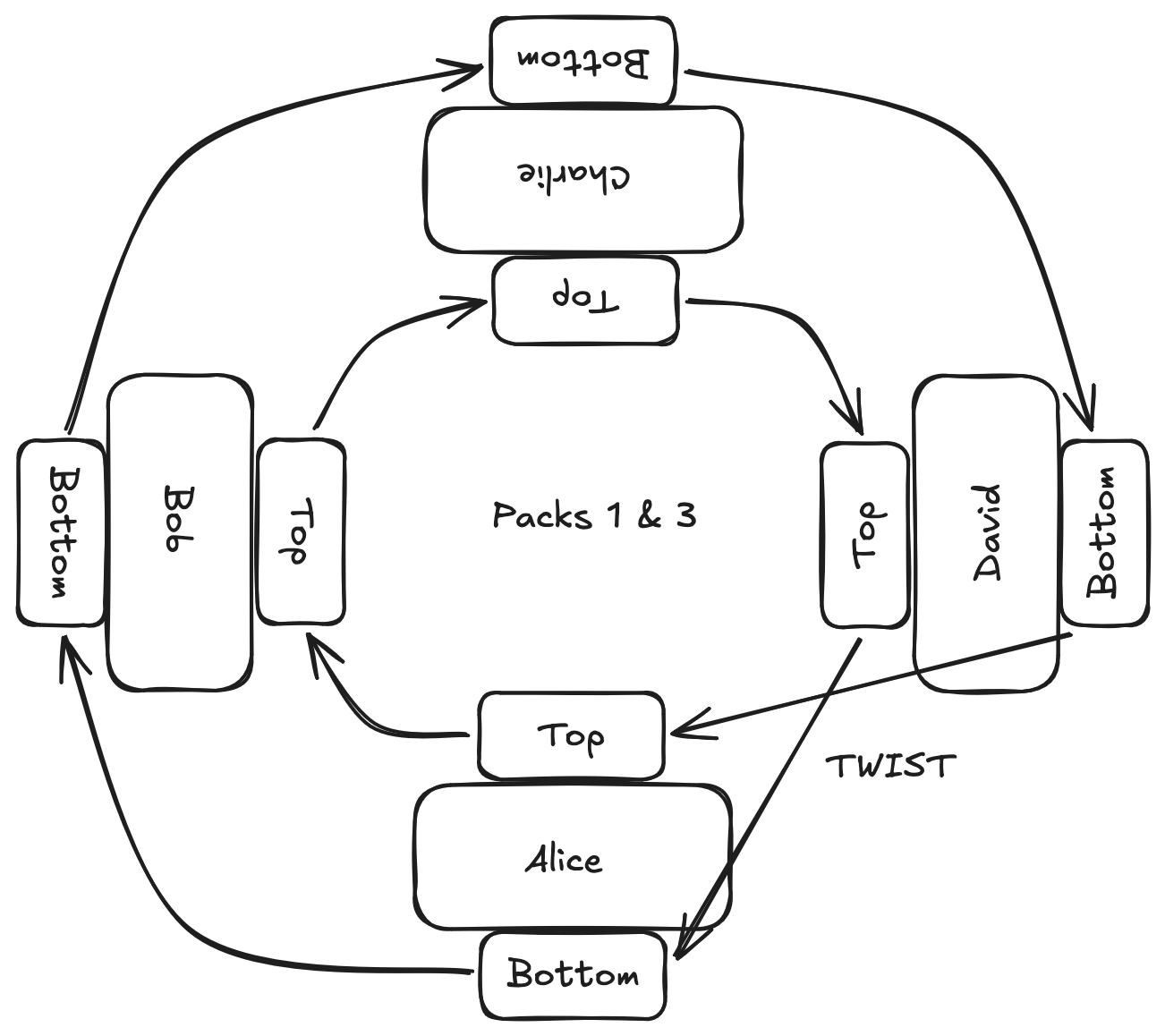
Packs 1 and 3 pack order (how a pack travels between the players): Alice Top -> Bob Top -> Charlie Top -> David Top -> Alice Bottom -> Bob Bottom -> Charlie Bottom -> David Bottom -> Alice Top
- Note: This means that every pack will alternate between each player’s top and bottom picks, with three picks from other players in between.
Packs 1 and 3 pick order for Alice:
- Alice Top pick 1 -> Bob Top
- NOTE: Alice passes to Bob on the same side because they do not form the twist. This is the typical behavior.
- Alice Bottom pick 1 -> Bob Bottom
- David Bottom -> Alice Top pick 2 -> Bob Top
- NOTE: David picks his top card first, so this pick needs to wait until David has finished 2 picks
- David Top -> Alice Bottom pick 2 -> Bob Bottom …
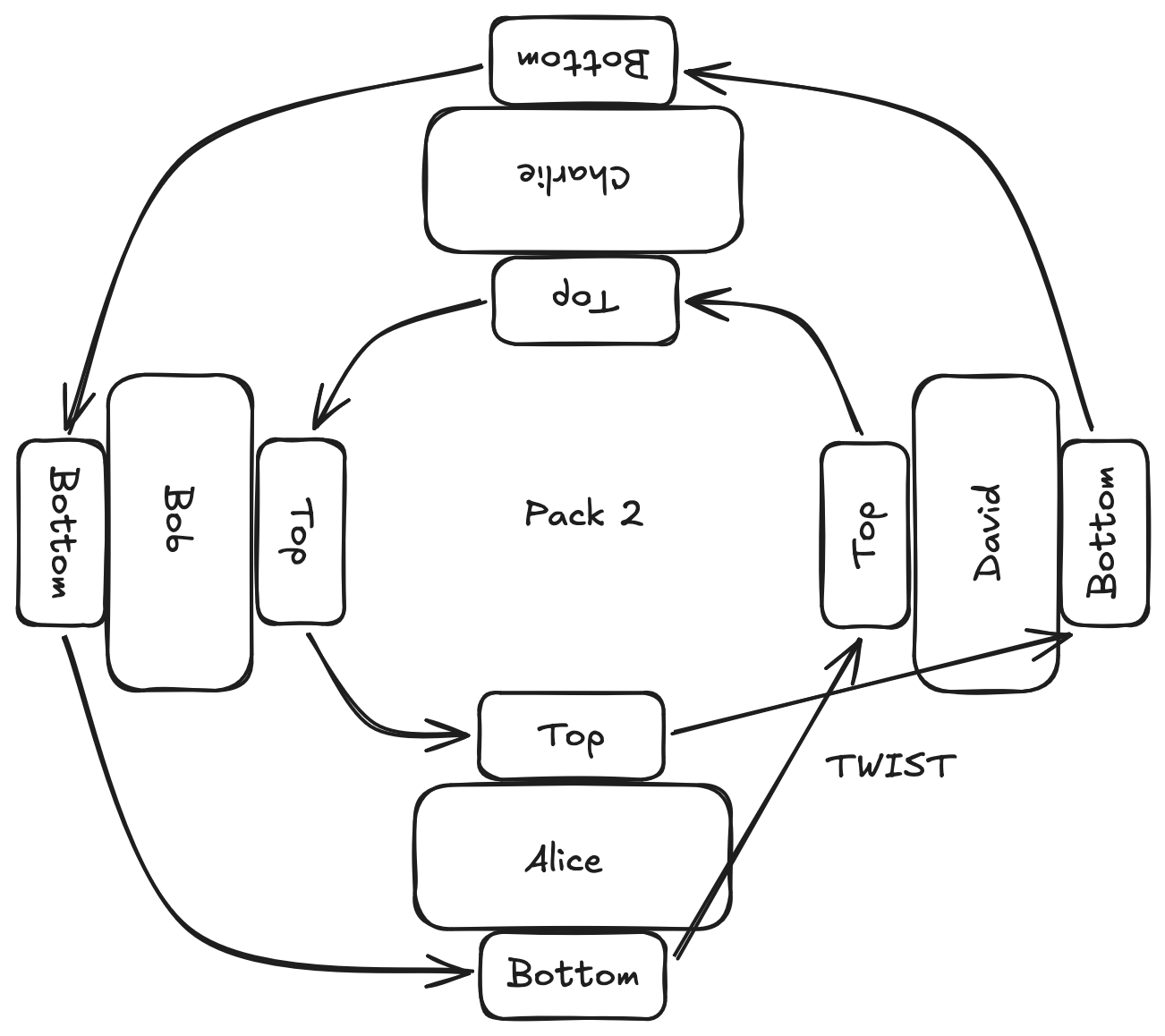
Pack 2 pack order (same as Pack 1 but in reverse): Alice Top -> David Bottom -> Charlie Bottom -> Bob Bottom -> Alice Bottom -> David Top -> Charlie Top -> Bob Top -> Alice Top
Pack 2 pick order for alice
- Alice Top pick 1 -> David Bottom
- NOTE: Alice passes to David on the opposite side because Alice and David form the twist.
- Alice Bottom pick 1 -> David Top
- Bob Top -> Alice Top pick 2 -> David Bottom
- NOTE: David picks his top card first, so this pick needs to wait until David has finished 2 picks
- Bob Bottom -> Alice Bottom pick 2 -> David Top …
Gameplay
Matches of the draft are held in best-of-three, but work slightly differently than regular drafts: instead of a player playing the same deck for all games, a player must win with each deck exactly once in the best of three. This is a similar format to “conquest” from Legends of Runeterra.
For the first game of the match, both players secretly choose which of their two decks they would like to play, without revealing to the other player.
When a player has won with a deck, they are not allowed to play with that deck for the remainder of the match. This means that, barring the round going to time, a player must win with both of their decks to win a match. As such, players must ensure both decks are capable of winning, and a player’s result is often dependent on how well their worse deck performs.
The losing player of the first game can choose to play the same deck or switch decks, in addition to the normal choice of play or draw. To discourage preboarding, a player is not allowed to sideboard against an opponent unless the player has already played against the deck they are about to face earlier in this match. The losing player must announce whether they are playing the same deck or switching to their other deck before sideboarding. In practice, this means that each player can sideboard at most once per match.
Gameplay Example
Alice is facing Charlie
- Game 1
- Alice secretly chooses her top deck
- Charlie secretly chooses his bottom deck
- Game 2
- Alice wins with her top deck, so she is required to choose her bottom deck
- Charlie can choose keep using the same deck or switch decks. He declares he is playing the same deck (bottom deck), so Alice can sideboard against Charlie. Charlie cannot sideboard against Alice because it’s a deck he has not seen in the match
- Game 3
- If Alice wins Game 2, the match is over
- If Charlie wins Game 2, both players must play with their deck that did not win yet.
- Alice plays with her bottom deck
- Charlie plays with his top deck
- Alice cannot sideboard against Charlie because it’s a deck she has not seen in this match. Charlie can sideboard against Alice.
If Charlie decided to switch decks after Game 1, then neither player would be able to sideboard after Game 1, and both players would be able to sideboard after Game 2. In all cases, both players would be able to sideboard once in a best-of-three match, unless the match ends after two games.
Additional notes
We have played Mobius draft with our cube group around ten times total, and found that it is a very interesting way to draft, especially with 4 players, as an alternative to pick-two drafting. We have found that it can be fun anywhere from 3-6 players, though higher player counts may require a larger-than-normal cube because each player uses 6 packs. We played Mobius draft mostly with Vintage cube, but we have also tried it with Secrets of Strixhaven draft and different cube. A Mobius draft tournament can be played either as a Swiss format or as a round robin.
Players are able to draft two decks at the same time, which increases play variety. Drafting becomes more strategic, as players have more information about cards they see in the other half of the loop, and there are decisions about what signals to pick up from the opposite pack, what might “wheel” from one of their decks to the other, how similar or different the two decks should be, and so on. We think that it’s potentially a format with a super high skill ceiling, and we have found that it’s harder to make optimal picks that take into account all of the extra information.
One downside is that the drafting portion takes longer to complete, though the gameplay matches take roughly an equal amount of time to regular drafting. Players may need slightly more frequent prompts to make sure they don’t take too long on each pick. The drafting portion is also more complicated so players must be more careful not to make mistakes (e.g. picking a card to the wrong deck, passing to the wrong row, messing up the twist). Another downside is that sideboarding is less prominent. We discussed an alternative rule of having open decklists with preboarding allowed but we have not yet tried it out. Finally, if using regular boosters, this draft format uses twice as many boosters so it would cost double the price compared to a regular draft.
Overall I think it’s a very worthwhile experience to try for a group of experienced drafters. Hope you enjoy it as much as we do!